

Have you ever noticed that the secular
world makes astonishing assumptions about our Catholic faith?
Secularists often will say really strange things about Catholics and
Catholicism and then react in shock when you correct them. I'm going
to run down a few of the basic weird statements made by secularists
that I've encountered, starting with this recent story:
The Tab reports that students mistook the white habit of a Dominican priest for thewhite hood of a Klansman. Yes, supposedly educated young people
couldn't tell the difference between one of the most iconic clergy
garbs and the outfits of an American terrorist organization. This is
what our culture has come to despite the default-clergy in Hollywood
films being a Catholic priest. Students were in such an uproar about
this 'armed Klansman' walking around campus (armed with his rosary
beads, which they thought was a whip) that some tweeted at campus
safety.
The idea that college students cannot
tell the difference between a priest and a Klansman is telling. The
Dominican Order is one of the most important religious orders in the
Church, boasting major saints like St. Dominic and St. Thomas
Aquinas, yet the image of the Dominican friar is one that can't be
distinguished from a KKK terrorist. Why is that?
The answer is relatively simple: deep
ignorance of Catholicism in a country whose religious roots are
Protestantism, especially Calvinism. The beliefs of these Protestant
offshoots of orthodox Christianity are what many Americans assume
when they think about Christians of any stripe. Here are a few
examples that illustrates my point:
- Many secularists assume that all Christians take the Bible literally. Genesis, Jonah, all of it is taken literally. Why do they assume this? Because guys like Ken Ham clearly and loudly proclaim that the Bible is to be taken literally on every page . Yet when Catholics point out that interpretation of Scripture should be done with a much more nuanced position, that some books are to be taken literally while others understood as epics, legends, or parables that contain critical and Spirit-inspired truth, we are accused of using a recent invention to pick and choose what we want to believe in the Bible. This despite evidence that the Church Fathers (those Christians of the Catholic Church in the 1st-8th centuries) interpreted the Bible that way. The Catechism describes Biblical Interpretation this way: “According to ancient tradition, one can distinguish between two senses of Scripture: The literal and the spiritual, the latter being subdivided into the allegorical, moral, and anagogical senses. The profound concordance of the four senses guarantees all its richness to the living reading of the Scripture in the Church” (CCC 115). In other words, some parts are to be taken literally, others not. All are to be taken as Spirit-inspired, with critical meaning and lessons and truth held therein. Some stories are more profound when understood allegorically. Jesus Christ used allegory and parables himself in his sacred ministry.
- Another fine example is the assumption that all Christians have a deep anti-science bias, despite the fact that science has never disproven a Christian dogma. The fact is, the Catholic Church affirms science. St. Thomas Aquinas famously declared that Christians should not reject the findings of science because to do so gives ammunition to anti-Christians everywhere. Today the Church employs a fair number of scientists in various positions, many of whom are also ordained priests. See the Vatican Observatory in Arizona as one such example.....or priests like George Mendel and George LeMaitre, two of the most important scientists in the modern era. The fact that both men are priests is ignored by history because it shows an inconvenient truth: that the Christianity and Science are not only compatible but that modern science wouldn't exist without the Church.
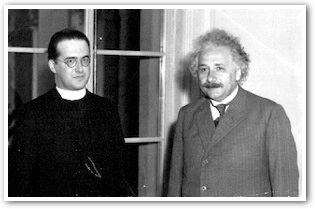 |
| Yes, that's Fr. LeMaitre on the left, next to Albert Einstein. Fr. LeMaitre discovered the Big Bang theory. |
Those are the two that come most
readily to mind. Please, if other misconceptions based on ignorance
come to mind put them in the comments or tweet them at me. For now
it's sufficient to say that we as Catholics have failed spectacularly
in reaching out to our peers. I live on and study at a college campus
in one of the most secular cities in the US...that just happens to
have deep Catholic roots. Yet ignorance of the Church here in
Portland is enormous. Our campus ministry does what it can to invite
students to learn more but ultimately it isn't up to priests and
those in religious life to reach out to the culture. It's up to us to
do it. I've failed in the past to do this. What have you done? We
have a lot of misconceptions to fend off. What will you do?

No comments:
Post a Comment
Thanks for reading!