Saturday, April 30, 2016

Signs On Our Heads

The second part of my series on surviving secular college is up and and can be read here. The topic is the need for a good Newman Center, though I suppose one could include the presence of an orthodox campus ministry in this as well. Have a look and, as always, if you like what you see here or there follow me!

In the Mass, when the Gospel is about to be proclaimed by the priest or deacon we make the sign of the cross on our foreheads, over our lips  and over our hearts. We do this to as a sign of the inward prayer in our hearts. In doing so we ask that the Gospel always be in our minds, on our lips, and in our hearts. Any Catholic is familiar with this concept but it does bear repeating occasionally because these things we do in the Mass can feel like rote repetitions with no real purpose if we fail to remind ourselves of their meaning from time to time.

But this shouldn't be the only use of this sign of the cross. The sign of the cross can be a powerful blessing upon ourselves or a subtle request for assistance in times of struggle. Have you had bizarre thoughts burst into your head? Be they sexual, judgmental, or just drifting off into la-la land, making the same sign of the cross on your head as done during the Gospel Acclamation can be a powerful way to restore mental order. This is due in large part to this being a moment of prayer.

Turning to prayer in these moments of weakness can be our most powerful response to moments of weakness. We're told often to turn to prayer when faced with mortal sin but obviously this is easier said than done. When the mind wanders into troubling areas such as sexual fantasies, dwelling on personal slights, or anything that reflects the pride that resides in virtually all of our hearts, turning to prayer can be hard if we are in a public setting. How do you make the normal sign of the cross while riding a bus or sitting in a restaurant or in a meeting at work?

This is why I turn to the sign from the Gospel Acclamation. The sign of the cross has been my most power weapon, when even a micro prayer is included, in keeping my mind clear of debris and spiritual landmines. We must always turn our minds and hearts in prayer to Christ when we are faced with the near occasion of sin, even when it's the hardest thing in the world to do. The sign from the Gospel Acclamation is a subtle way of doing so when you wish to be discrete and silent in your prayerful appeals to the Lord for help.

Is there any support in Scripture for doing this? We see the faithful in both the Old and New Testaments has bearing signs on their foreheads marking them as the elect (Exodus 17:9-14 and Revelation 7:39:414:1). We also know that in the early Church the sign of the cross was commonplace. Tertullian writes "In all our travels and movements, in all our coming in and going out, in putting on our shoes, at the bath, at the table, in lighting our candles, in lying down, in sitting down, whatever employment occupies us, we mark our foreheads with the sign of the cross" (De corona, 30). This sign reminds us of the Holy Trinity, that doctrine of doctrines that separates Christians from other Abrahamic faiths, and invokes the Trinity to be with us in prayer. When turning in appeal to prayer for overcoming dangerous situations the sign of the cross, either the full sign or the Acclamation sign, can be a powerful weapon for overcoming temptation.


Wednesday, April 20, 2016

Catholics and Earth Day


The environment and our relationship with it has become one of the recurring and dominant topics of our societal discourse in the last decade. Few topics have their own holiday but the environment certainly does: Earth day. The day dates back to the birth of the contemporary environmental movement in 1970. According to the Earth Day network the purpose of the day was to have a “national teach-in on the environment” that mobilizes the people and politicians of the world to respond to the environmental crisis.

The day and the environmental movement have deeply pagan ideas at the core of the movement, including anthropomorphism of the Earth. By this I mean the idea that Earth is our 'mother,' most evident in the concept of Gaia the pagan Earth Goddess. Many Christians, myself included, have difficulty accepting the motives of the environmental movement due to the overt pagan nature of the movement. It, like the modern 'social justice' movement, bears all the hallmarks of a religion. There are creeds, a formal magisterium, and heretics. Now there's a call for an Inquisition, not like the one in history but the distorted vision of an Inquisition taught in our secular Protestant schools.

You may think from all of this that I deny human caused climate change. I don't, actually. I'm in the early stages of writing a doctoral dissertation on Catholic Social Teaching as it relates to sustainable development. As it happens I tend to agree that the evidence points to the climate changing and that we, collectively, need to continue to investigate the causes as well as the claims that the data is being distorted purposefully by the scientific community. True scientific skepticism requires no less.

What duty do Christians have to the environment? Like everything else in our faith, the duty of Catholics is one of relationship.We are called to have a relationship with God, right? Genesis tells us that we were given the Earth to till, work, and keep. In Laudato Si, Pope Francis reiterates what John Paul II and Pope Emeritus Benedict XVI both taught, that we were given the Earth as stewards. Stewardship has long been a concept in Catholic Social Teaching, taught traditionally as our individual and collective responsibility towards our brother and sister.

Stewardship of creation is hard for some to grasp so I'll use a metaphor. Suppose your father restored a classic car by hand. The car meant a lot to him, going so far as to call the car the most beautiful he had seen. On your 16th birthday, after getting your license, he gives you the keys to car to drive to school, work, and on dates. How would you treat the car? In theory you'd treat the car with respect because you know how much work your father put into building the car and how much he loved it. You'd know that the car was given to you as a sign of your maturity, at least in theory. Of course, being a 16 year old sinner you'd likely drive the car less-than carefully, and likely would do damage to it.

That's the situation we are faced with. We've taken creation, which we are to be stewards of, and abused it, going beyond tilling and keeping the Earth and instead have decided, in the words of Pope Francis, that the Earth that God declared to be 'good' was not 'good enough' and have polluted the place in the name of greed and selfishness. That'd be a bit like taking your dad's classic car and putting a hideous, ugly plastic neon green spoiler on it and dumping fuel additives that add power but damage the engine to better facilitate drag racing.

The way we treat the Earth should reflect our attitudes towards God and towards one another. This is a concept too complex for a short blog post but the essence of this is this: we are commanded to love one another and to love God. Our love of God should extend to those things he has entrusted to our care, whether its creation or our brothers and sisters who are at vulnerable. Just as abortion is a condemnation of our love for one another, so too are acidic seas, industrial run off that kills streams, and forest management practices that both leave forests more prone to wildfires and leave local populations unemployed.  We are to treat creation with respect not because creation is a god or goddess of some kind but because they are the property of God entrusted to us. So on this Earth day reflect on both the disordered way the secular world celebrates creation and our own attitudes towards the Earth and our relationship to God. Everything should come back to that relationship. That's part of the joy of Catholicism: everything is about relationships. Let's act like it.

Wednesday, April 13, 2016

Bored?

First, a quick announcement: I've started blogging over at Catholic365. My first couple of pieces there will be about choosing a secular college wisely, so go have a look. I should be posting there about once each week and have no intention of letting this outlet go by the wayside. 

Now that that's out of the way.....[insert awkward segue].....today's topic: boredom. We live in a culture that is increasingly bored. People seek to fill the meaningless vacuum of their lives with increasingly shocking fare in order to alleviate the sense of purposelessness that permeates everything in the secular world. The problem is this: boredom is a sign that there is a widespread problem in society. No good Christian should be bored, for GK Chesterton states in his usual blunt manner why we shouldn't be bored at all:

“A child kicks his legs rhythmically through excess, not absence, of life. Because children have abounding vitality, because they are in spirit fierce and free, therefore they want things repeated and unchanged. They always say, ‘Do it again’ … Perhaps God is strong enough to exult in monotony. It is possible that God says every morning, ‘Do it again’ to the sun; and every evening, ‘Do it again’ to the moon. It may not be automatic necessity that makes all daisies alike; it may be that God makes every daisy separately, but he never got tired of making them. It may be that He has the eternal appetite of infancy; for we have sinned and grown old, and our Father is younger than we. The repetition in Nature may not be a mere recurrence; it may be a theatrical encore.” (Chesterton, Orthodoxy, pg 41)

Boredom is a sign of purposelessness. No Christian should live without purpose. We should find wonder in everything, for the hand of the Creator is evident in everything in the world. Yet we live in a bored culture. We live in times where scientific knowledge is expanding and providing insights into the mystery of creation and the seemingly boundless nature of creation....yet people are bored. We live in times where people can communicate with others from around the world, in cultures vastly different yet oddly familiar to us, yet people are bored.

Elsewhere, Chesterton tells us that we've lost our sense of awe. Perhaps it's the consequence of the constant stream of information we're subject to now. Maybe it's the increasingly shocking nature of music, movies and media that thrive on more and more excess, leaving the population jaded. Pope Benedict XVI and Pope Francis have long recommended Robert Hugh Benson's Lord of the World, a dystopian end-times novel written in 1907 that has a sign of the end of days being rampant boredom. I just bought a copy and will write and post a review here. Personally I love dystopian fiction (1984 and Brave New World are favorites of mine) so I'm definitely looking forward to reading this.  I haven't any idea if boredom is a sign of something as spiritually apocalyptic as Hugh's thesis but I definitely believe it to be a sign of spiritual famine. Boredom and a love of Christ shouldn't go together. No Christian has reason to be perpetually bored. 


Wednesday, April 6, 2016

Navigating an Ignorant Secular Society


Have you ever noticed that the secular world makes astonishing assumptions about our Catholic faith? Secularists often will say really strange things about Catholics and Catholicism and then react in shock when you correct them. I'm going to run down a few of the basic weird statements made by secularists that I've encountered, starting with this recent story:

The Tab reports that students mistook the white habit of a Dominican priest for thewhite hood of a Klansman. Yes, supposedly educated young people couldn't tell the difference between one of the most iconic clergy garbs and the outfits of an American terrorist organization. This is what our culture has come to despite the default-clergy in Hollywood films being a Catholic priest. Students were in such an uproar about this 'armed Klansman' walking around campus (armed with his rosary beads, which they thought was a whip) that some tweeted at campus safety.

The idea that college students cannot tell the difference between a priest and a Klansman is telling. The Dominican Order is one of the most important religious orders in the Church, boasting major saints like St. Dominic and St. Thomas Aquinas, yet the image of the Dominican friar is one that can't be distinguished from a KKK terrorist. Why is that?

The answer is relatively simple: deep ignorance of Catholicism in a country whose religious roots are Protestantism, especially Calvinism. The beliefs of these Protestant offshoots of orthodox Christianity are what many Americans assume when they think about Christians of any stripe. Here are a few examples that illustrates my point:

  • Many secularists assume that all Christians take the Bible literally. Genesis, Jonah, all of it is taken literally. Why do they assume this? Because guys like Ken Ham clearly and loudly proclaim that the Bible is to be taken literally on every page . Yet when Catholics point out that interpretation of Scripture should be done with a much more nuanced position, that some books are to be taken literally while others understood as epics, legends, or parables that contain critical and Spirit-inspired truth, we are accused of using a recent invention to pick and choose what we want to believe in the Bible. This despite evidence that the Church Fathers (those Christians of the Catholic Church in the 1st-8th centuries) interpreted the Bible that way. The Catechism describes Biblical Interpretation this way: “According to ancient tradition, one can distinguish between two senses of Scripture: The literal and the spiritual, the latter being subdivided into the allegorical, moral, and anagogical senses. The profound concordance of the four senses guarantees all its richness to the living reading of the Scripture in the Church” (CCC 115). In other words, some parts are to be taken literally, others not. All are to be taken as Spirit-inspired, with critical meaning and lessons and truth held therein. Some stories are more profound when understood allegorically. Jesus Christ used allegory and parables himself in his sacred ministry.
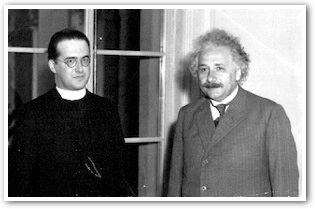
  • Another fine example is the assumption that all Christians have a deep anti-science bias, despite the fact that science has never disproven a Christian dogma. The fact is, the Catholic Church affirms science. St. Thomas Aquinas famously declared that Christians should not reject the findings of science because to do so gives ammunition to anti-Christians everywhere. Today the Church employs a fair number of scientists in various positions, many of whom are also ordained priests. See the Vatican Observatory in Arizona as one such example.....or priests like George Mendel and George LeMaitre, two of the most important scientists in the modern era. The fact that both men are priests is ignored by history because it shows an inconvenient truth: that the Christianity and Science are not only compatible but that modern science wouldn't exist without the Church. 
Yes, that's Fr. LeMaitre on the left, next to Albert Einstein.
Fr. LeMaitre discovered the Big Bang theory.
Those are the two that come most readily to mind. Please, if other misconceptions based on ignorance come to mind put them in the comments or tweet them at me. For now it's sufficient to say that we as Catholics have failed spectacularly in reaching out to our peers. I live on and study at a college campus in one of the most secular cities in the US...that just happens to have deep Catholic roots. Yet ignorance of the Church here in Portland is enormous. Our campus ministry does what it can to invite students to learn more but ultimately it isn't up to priests and those in religious life to reach out to the culture. It's up to us to do it. I've failed in the past to do this. What have you done? We have a lot of misconceptions to fend off. What will you do?