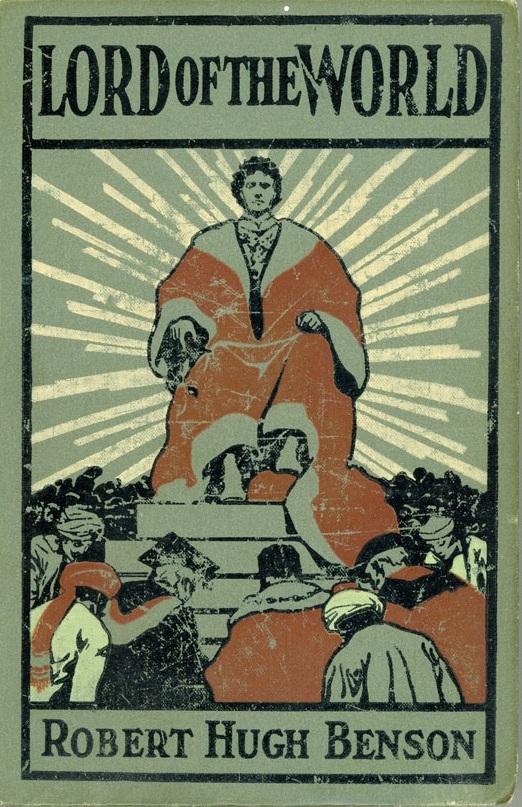
When a book is recommended by both Pope Emeritus Benedict XVI and Pope Francis it's worth considering. When that book is a 1984-esque scifi novel, well, I was intrigued. I'm not normally one to take book reviews from public figures too seriously but when two very, very different popes make a book recommendation it's worth heading.
The book? Lord of the World by Robert Hugh Benson, which tells the tale of a world gone fully secular. Protestantism is dead, Catholicism largely irrelevant to the public sphere, and Islam reduced to a handful of true believers. Secular humanism and all of the evils that are inevitable with it (loss of human dignity chief among them) reigns supreme. Into this environment a charismatic leader with an almost supernatural ability to charm people rises. Only the few Catholics in society oppose him, leading to the Church being driven underground. This novel is an end-times piece, a sort of Catholic Left Behind without any of the non-scriptural 'rapture' stuff that end-timers believe in for some reason.
Why was this book heavily recommended by Pope-Emeritus Benedict XVI and Pope Francis? If you read Lord of the World you'll see why pretty quickly. While the author gets a lot of his predictions about the future wrong (Telegraphs and typewriters in the mid-21st century?!) the meat of the story revolves around what St. John Paul II called the Culture of Death. Key features of the culture include rampant boredom, self-centeredness, and easily available euthanasia. One wonders if the author chose not to touch the issues of sexuality and abortion due to his own religious convictions and sense of propriety.
Regardless, euthanasia is a central and looming issue in the story. Instead of paramedics the emergency responders provide euthanasia. Depression, which runs rampant in the culture, can be cured with legally sanctioned suicide. If this seems far fetched consider that in 2013 the Dutch euthanized 650 newborn babies. Not abortions but the killing of newborn babies,sanctioned by the state and accepted by a population so numbed to the basic requirements of humanity because they have largely turned their backs on the faith.
That is the direction our culture is heading in, if Islam doesn't conquer the west first. Lord of the World details the rise of the anti-Christ amidst this cesspool of indifference, coming from the world of politics. He has no faith but in Humanity and institutes worship of idols to restore a sense of purpose in the population. He is seductive, mysterious, magnetic...and American. The author is British, which may explain that touch, though we shouldn't fool ourselves into thinking that America couldn't produce such a figure.
Written in 1907 Lord of the World is a startling book that is still relevant today for any Christian with a taste for science fiction. I recommend it highly, giving it 4/5 stars. My only complaint is that there are parts of the book written in Latin (having to do with the Mass) and, given that I am unfamiliar with the Tridentine Mass, don't understand Latin. Call that the failings of being a convert. The book can be purchased cheaply from Amazon through the link on the sidebar if interested.
Tuesday, May 24, 2016
Monday, May 16, 2016
Musings on the Dignity of Work
Few people enjoy looking for a job. It's one of the most depressing bits of drudgery we can find ourselves involved, regardless of whether or not we're employed while we look. I'm presently seeking a new job despite having two part time jobs at the moment. Instead of another part time job or one one that pays like one I'm seeking a full time job. Yeah, me and everyone else it seems. It's an open secret that the economy is in a pretty rough place at the moment, with economic growth stagnant and job creation middling along at a snails pace.
Catholic Social Teaching formally teaches that the economy must serve people first. The Bishops and the Magisterium have a lot to say on this subject but in the end it all boils down to the radical idea that all things in life must place human beings and their liberty to pursue family and God first. We are not cogs in a machine, regardless of what the corporate capitalists or socialist will say. Man has a purpose, which is to know and love God in this life so we may be perfected and join him in the next.
They say you can't run an economy on the pursuit of God. Perhaps not, but it seems you can't run an economy based on pursuing nothing but profits either. There are those that say that work is the pure purpose of man and that we were made for work. CST teaches the opposite: that work was made for man. We are perfected in work. Work is almost sacramental in nature. How do we know this? The Bible begins with God working. In all things we are to emulate God. Our missions as Christians is to become Christ-like, to be Christ in the world. One means we have is work. Thus we work, either for ourselves or others, and put our all into the work we do, which when it is right-ordered perfects us. Work brings us closer to God.
This of course means that we have duties in the work we do. Christians shouldn't engage in work that separates us from God, work that is sinful in nature. I'd be suspicious of Christian abortionists or Christian strippers or any having any other job whose work by its very nature is offensive to God and violates His commandments. This is doubly true for Christians in political work. Can a Christian work for a socialist? I doubt it, given the history of hostility towards the faith by socialist governments, even the supposedly democratic ones.
Funny enough the formal teaching of the Church relies on property ownership being widespread. Employers are encouraged to share ownership of the organization with employees. Individually we should be owning land or shops or whatever other 'means of production' is available to us. The idea is to be both economically independent and interdependent -- that is, we must recognize that through work we build the Church through greater brotherhood with our neighbors. That's the rub: work brings us together. As in everything in Catholic Social Teaching and in the faith more broadly, it's about relationships. So pray that I find work as I continue looking and applying. I'm not being super picky, other than avoiding problematic jobs.
Catholic Social Teaching formally teaches that the economy must serve people first. The Bishops and the Magisterium have a lot to say on this subject but in the end it all boils down to the radical idea that all things in life must place human beings and their liberty to pursue family and God first. We are not cogs in a machine, regardless of what the corporate capitalists or socialist will say. Man has a purpose, which is to know and love God in this life so we may be perfected and join him in the next.
They say you can't run an economy on the pursuit of God. Perhaps not, but it seems you can't run an economy based on pursuing nothing but profits either. There are those that say that work is the pure purpose of man and that we were made for work. CST teaches the opposite: that work was made for man. We are perfected in work. Work is almost sacramental in nature. How do we know this? The Bible begins with God working. In all things we are to emulate God. Our missions as Christians is to become Christ-like, to be Christ in the world. One means we have is work. Thus we work, either for ourselves or others, and put our all into the work we do, which when it is right-ordered perfects us. Work brings us closer to God.
This of course means that we have duties in the work we do. Christians shouldn't engage in work that separates us from God, work that is sinful in nature. I'd be suspicious of Christian abortionists or Christian strippers or any having any other job whose work by its very nature is offensive to God and violates His commandments. This is doubly true for Christians in political work. Can a Christian work for a socialist? I doubt it, given the history of hostility towards the faith by socialist governments, even the supposedly democratic ones.
Funny enough the formal teaching of the Church relies on property ownership being widespread. Employers are encouraged to share ownership of the organization with employees. Individually we should be owning land or shops or whatever other 'means of production' is available to us. The idea is to be both economically independent and interdependent -- that is, we must recognize that through work we build the Church through greater brotherhood with our neighbors. That's the rub: work brings us together. As in everything in Catholic Social Teaching and in the faith more broadly, it's about relationships. So pray that I find work as I continue looking and applying. I'm not being super picky, other than avoiding problematic jobs.
Saturday, May 7, 2016
Our Duties At the Start of This General Election
The advent of another general election season is upon Americans as the presidential primary season draws to a close. Given that the two major party candidates are historically unpopular, many voters, especially Christians, are expressing hostility to both candidates. Not liking either candidate is understandable. What isn't understandable is refusing to vote in the general election.
The Magisterium of the Church formally teaches that the typical Catholic in a country with free and fair elections has a responsibility to vote. This duty to vote is based on the teaching of Our Blessed Lord to spread the Gospel. Spreading the Gospel includes being witness in the electoral system by using the message of the Lord when we vote. There is no separation of Church and State in this regard, at least not in the way the secular world expects. We are not to leave our values at home when we vote. We are expected to bring Christ's love to the world. Yet, when we speak of love we forget that Christ's love included His speaking difficult truths to those whom He spoke. This can, and does include subjects that mark Christians as being intolerant (in the 'logic' of the secular world). The secular world, and we ourselves, often confuse Christ's love and tolerance He preached with blind acceptance of problems.
So where does that leave us in this general election? Periodically the US Bishops release Forming Consciences for Faithful Citizenship, a sort of guide for principled Catholic voting. It's not a partisan document, rather it's meant to inform the conscience of prospective voters. The US Bishops are Apostolic men and thus these words bear weight for any Catholic who claims to be faithful to the Church. Lately I've seen a lot of chatter online about how priest X in diocese Y says no faithful Catholic can vote for Candidate Z. With respect to the priesthood, these are the opinions of individual priests. They may or may not be correct. Rather, the tenor and tone of their statement when compared to that of the Bishops is a better guide. The Bishops make no overt claims about any candidate in the elections. Rather, certain principles emerge that help form our voting conscience. These principles are the core of Catholic Social Teaching: The Dignity of the Human Person, Subsidiarity, Solidarity, and the Common Good (or charity). In addition, certain issues are non-starters for any candidate, that is, traditional marriage, abortion, and euthanasia.
I'm not going to define each of those concepts, as that is the stuff of philosophy and political theory. Indeed, I'm doing just that in my doctoral dissertation and the length required to do those concepts justice isn't appropriate for a short blog post. Suffice it to say those principles combined with those issues that cannot be compromised are meant to be our starting points in voting. In my life this has made voting harder, not easier, because no candidate falls in line with those concepts perfectly. So what are we to do? We do the best we can. In the current election are choices come down to a candidate who passionately supports late term abortion, gay 'marriage,' and other issues that embrace those non-starters. Their opponent is a brash person who has changed their opinion on all manner of topics and uses harsh and crass language to describe cultural outsiders. So the task isn't easy, but we have no excuse to not vote. Pray, fast and then vote. That may be the only options you have. And remember: Christ expressed his love of those who didn't love him by pointing out difficult and unpopular truths. Surely they thought He was hateful or crossing the line. We cannot project our internal sinful response to words or positions taken by candidates onto those candidates by dehumanizing them, by turning them into hateful demagogues. That is the way of the world. It is not the way of Christ.
The Magisterium of the Church formally teaches that the typical Catholic in a country with free and fair elections has a responsibility to vote. This duty to vote is based on the teaching of Our Blessed Lord to spread the Gospel. Spreading the Gospel includes being witness in the electoral system by using the message of the Lord when we vote. There is no separation of Church and State in this regard, at least not in the way the secular world expects. We are not to leave our values at home when we vote. We are expected to bring Christ's love to the world. Yet, when we speak of love we forget that Christ's love included His speaking difficult truths to those whom He spoke. This can, and does include subjects that mark Christians as being intolerant (in the 'logic' of the secular world). The secular world, and we ourselves, often confuse Christ's love and tolerance He preached with blind acceptance of problems.
So where does that leave us in this general election? Periodically the US Bishops release Forming Consciences for Faithful Citizenship, a sort of guide for principled Catholic voting. It's not a partisan document, rather it's meant to inform the conscience of prospective voters. The US Bishops are Apostolic men and thus these words bear weight for any Catholic who claims to be faithful to the Church. Lately I've seen a lot of chatter online about how priest X in diocese Y says no faithful Catholic can vote for Candidate Z. With respect to the priesthood, these are the opinions of individual priests. They may or may not be correct. Rather, the tenor and tone of their statement when compared to that of the Bishops is a better guide. The Bishops make no overt claims about any candidate in the elections. Rather, certain principles emerge that help form our voting conscience. These principles are the core of Catholic Social Teaching: The Dignity of the Human Person, Subsidiarity, Solidarity, and the Common Good (or charity). In addition, certain issues are non-starters for any candidate, that is, traditional marriage, abortion, and euthanasia.
I'm not going to define each of those concepts, as that is the stuff of philosophy and political theory. Indeed, I'm doing just that in my doctoral dissertation and the length required to do those concepts justice isn't appropriate for a short blog post. Suffice it to say those principles combined with those issues that cannot be compromised are meant to be our starting points in voting. In my life this has made voting harder, not easier, because no candidate falls in line with those concepts perfectly. So what are we to do? We do the best we can. In the current election are choices come down to a candidate who passionately supports late term abortion, gay 'marriage,' and other issues that embrace those non-starters. Their opponent is a brash person who has changed their opinion on all manner of topics and uses harsh and crass language to describe cultural outsiders. So the task isn't easy, but we have no excuse to not vote. Pray, fast and then vote. That may be the only options you have. And remember: Christ expressed his love of those who didn't love him by pointing out difficult and unpopular truths. Surely they thought He was hateful or crossing the line. We cannot project our internal sinful response to words or positions taken by candidates onto those candidates by dehumanizing them, by turning them into hateful demagogues. That is the way of the world. It is not the way of Christ.
Subscribe to:
Posts (Atom)
